
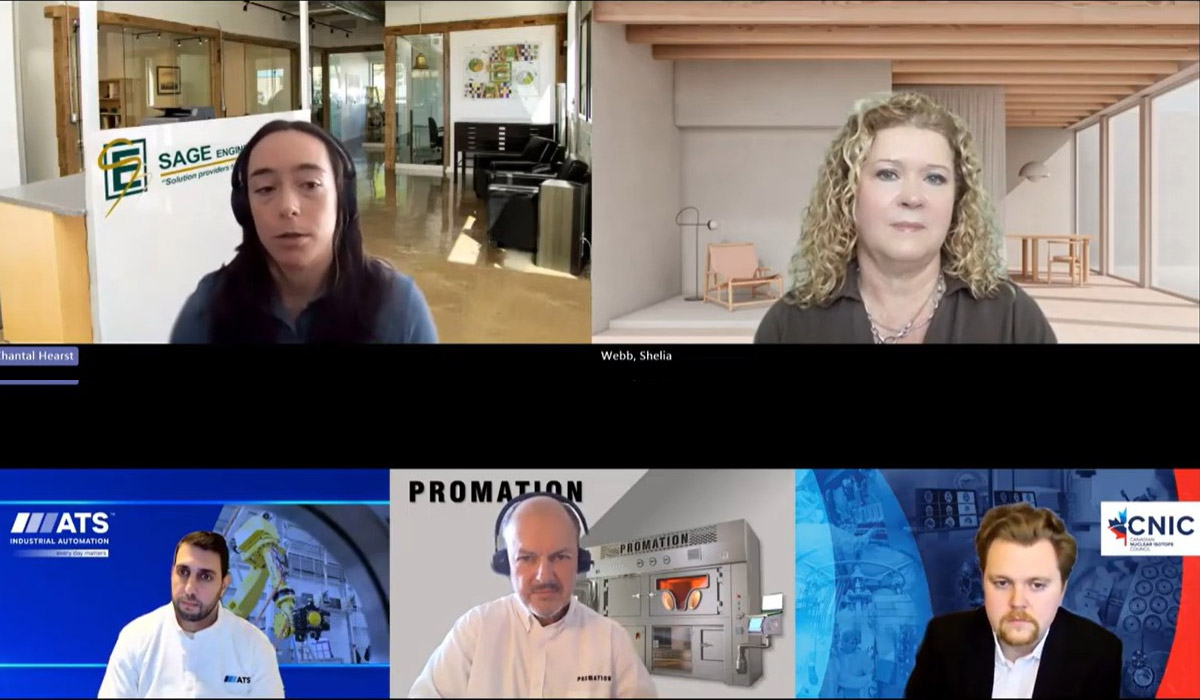
Our very own Chantal Hearst recently participated as a panelist at the Canadian Nuclear Isotope Council’s (CNIC) event—Automation & Technology: Powering Canadian Isotope Innovation.
As automation, specialized equipment, and digital technologies continued to transform radiopharmaceutical and isotope manufacturing, this discussion explored both the opportunities and challenges associated with reducing risk, improving quality, and expanding capacity across the sector.
With years of experience delivering automation-driven packaging and radiopharmaceutical manufacturing projects in regulated environments, Chantal contributed practical insights on implementing compliant, scalable, and efficient automated solutions across isotope supply chains.
Here are some key takeaways and considerations when deciding When to Automate:
The drive toward automation in the radiopharmaceutical industry is ubiquitous due to many factors – not least of which is the protection of operations personnel from potentially harmful radiation exposure.
More recently, new drivers have emerged that further accelerate movement toward automation. The market for isotopes is rapidly expanding as global demand rises, and new drug approvals are shifting from clinical scale to commercial scale production. As production volumes grow, organizations are seeking ways to increase throughput, which naturally pushes the conversation toward greater automation.
In parallel, technology is evolving and more advanced off the shelf equipment is becoming commercially available each year, making it possible to automate more complex processes that would previously have required fully custom solutions. Together, these factors are creating both the opportunity and the incentive to rethink current processes and explore more automated, scalable approaches.
Why It’s Not a Simple Decision
Due to the inherent safety risks of handling radioactive materials, there is a strong incentive to automate processes early to reduce operator exposure – yet this must be balanced against the feasibility and suitability of automating specific tasks.
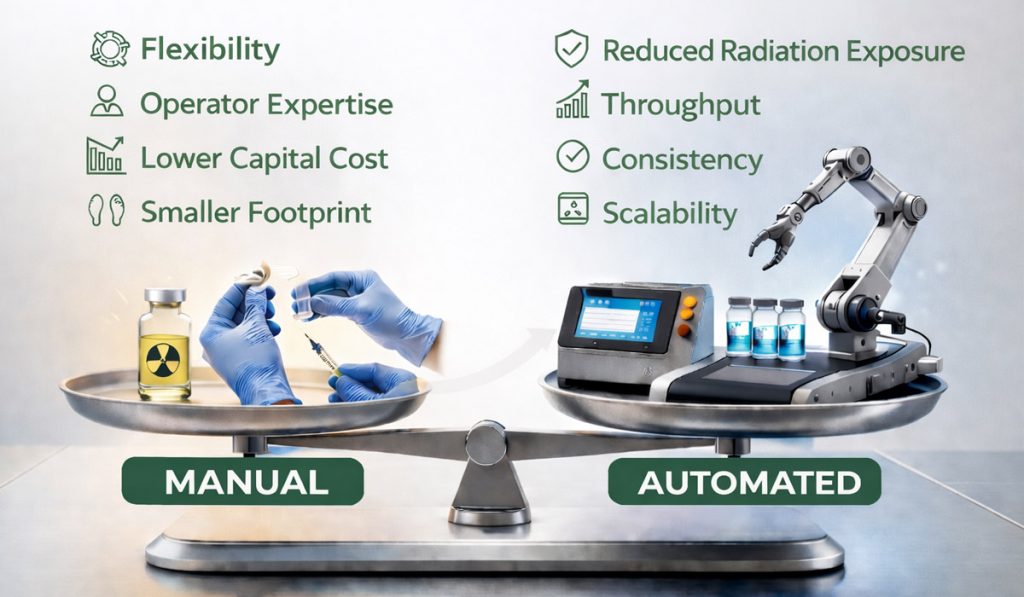
It is important to carefully assess, through a risk based approach, which operations are the most appropriate for automation and which involve more complex processing that is better performed by a skilled operator. While machines excel at performing unit operations in a repeatable and reliable manner – and often much faster than a human - not all tasks fit this profile.
Some activities require decision making, adaptability, or fine manipulation. For example, adjusting process parameters during formulation, performing delicate manipulations during aseptic dispensing, or conducting visual inspection can be difficult for current automated systems to replicate. In these cases, automation may increase the risk of false rejects, which can be very costly to reprocess or dispose of.
Cost and practicality add further layers of complexity. Specialized automation equipment requires substantial capital investment, so organizations must evaluate whether the longterm return on investment justifies the initial cost, especially when production forecasts fluctuate or processes are still evolving. Physical space constraints can also limit options: automated systems generally require a larger footprint to accommodate safety guarding, mechanical and electrical components, airflow controls, and the operational needs of the equipment itself.
As a result, deciding what to automate becomes a multidimensional challenge that must weigh safety, complexity, economics, and facility limitations rather than approaching automation as a binary choice.
The SAGE Perspective
In our experience, it is essential to understand the drivers behind a decision to automate and think critically about the factors at play both now and in the medium term. Transitioning from a manual process to an automated one is a labour- and resource-intensive process that requires buy-in from stakeholders at multiple levels to succeed. It is important to be confident in the decision and planned outcomes as an organization, so that all parties involved can push toward the same objective.
Automation is an extremely powerful tool in manufacturing, but it is not without its limitations and trade-offs. The long-term trajectory for any manufacturing organization certainly includes increased automation, but the real challenge lies in determining when – and how much – to automate as you progress incrementally along your automation journey.
As an engineering partner, SAGE is here to support organizations as they navigate these decisions -from early stage automation strategy through to detailed design and implementation. If you’re considering how to scale or automate your radiopharmaceutical processes, we’d be happy to discuss how we can help.